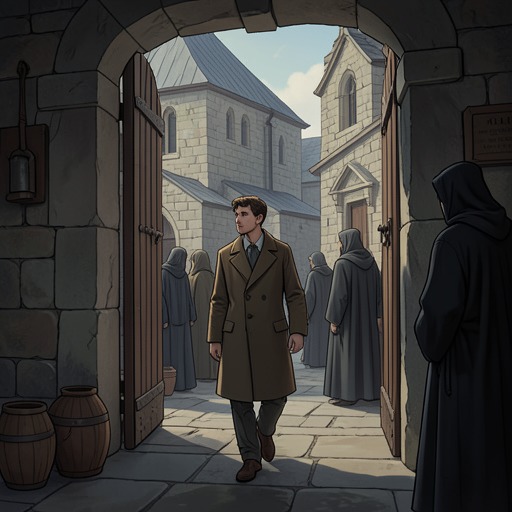
Knecht’s Mariafels Mission and Castalia–Rome Rapprochement
The Glass Bead GameKnecht’s Mariafels Mission and Castalia–Rome Rapprochement is a diplomatic assignment that becomes an intellectual exchange. Sent to explain Castalia to Father Jacobus and win support for closer relations with Rome, Knecht finds that teaching his host also exposes the historical limits of his own education. The resulting collaboration changes Jacobus’s view of the Glass Bead Game and helps lay the groundwork for lasting ties between Castalia and the Roman Church.
Assignment and Initial Divide
Knecht’s task was to present the nature of Castalia and its system to Father Jacobus, a Benedictine scholar whose formidable knowledge of history was matched by his distrust of the Castalian Order. Jacobus regarded it as an imitation of Christian institutions without religion, God, or Church at its foundation. Knecht answered that religious life and thought had taken forms beyond Benedictine and Roman Catholic tradition, and that Castalia’s intentions and influence could not simply be dismissed. The disagreement made their assignment more than a matter of securing approval: it required each man to understand a tradition the other considered inadequate.
The tension also centered on the Glass Bead Game’s spiritual claim. Jacobus initially saw its learned combinations as play, not a sacrament. Castalia, however, had developed the Game into a synthesis of intellectual disciplines and artistic forms, treating it as a path toward perfection and a unifying practice for the learned community. Its symbolic language could incorporate Christian texts and concepts alongside mathematical axioms and music, and among committed players the Game could function almost as worship, even though it deliberately developed no theology of its own. The difference between a religious institution and a secular order borrowing religious forms was therefore at the heart of the mission.
Teaching in Both Directions
Knecht’s instruction in Castalia’s history and the Game did not remain a one-sided diplomatic presentation. In return for Jacobus’s lessons in historical science, Knecht introduced him to Castalia’s organization and to the ideas underlying the Game. The roles of teacher and pupil repeatedly shifted: Jacobus listened closely, challenged claims, and questioned the assumptions within Knecht’s account. He remained distrustful even after becoming more receptive, and his criticism did not disappear when he was prepared to recommend rapprochement.
Preparing to teach forced Knecht to revisit books on Castalia’s constitution, history, elite schools, and the development of the Game. Some had once helped him in his youthful dispute with Plinio Designori; others, intended for Castalian officials, had been inaccessible to him as a student. He recognized that his own picture of the historical conditions behind the Order was pale and schematic. Jacobus helped him place Castalia’s development within the broader history of nations, while Knecht tried to render the Castalian system intelligible to his demanding listener. Their debates, often passionate, sharpened both men’s understanding and continued to influence Knecht long after the mission.
From Dispute to Rapprochement
Jacobus’s change of attitude came through sustained study, not a sudden abandonment of his reservations. He eventually asked to be introduced to the theory of the Game, sensing in it the secret of the Order and what might be called its faith. Though too old to become a player, he pursued the subject with determination. His resulting support mattered beyond the private relationship: he became one of the most earnest and influential friends of the Game and the Order outside Castalia.
The institutional consequences accumulated gradually. Jacobus’s attention to Knecht’s explanations and his growing appreciation of Castalia helped produce benevolent neutrality between Rome and the Province, followed by occasional scholarly exchanges, cooperation, and alliance. In time, these contacts yielded a concord that continued into the narrator’s present. The mission thus secured more than assent to an immediate diplomatic step: it opened a durable channel between communities whose intellectual honesty and religious commitments could have driven them toward confrontation.
Mission’s Outcome and Meaning
Near the end of the assignment, Jacobus wrote to the leadership of the Castalian Order agreeing to the proposed diplomatic measure. He also requested permission for Knecht to remain longer, describing him as a popular Glass Bead Game player who had been giving him private instruction. The Castalian authorities granted the request and sent Knecht a commendation for the mission. Its most welcome news was that, once his assignment was complete, the Order was prepared to grant his wish to return to the Vicus Lusorum. Knecht had feared permanent separation from Castalia, even the possibility of being sent to Rome; Jacobus’s support helped turn that anxiety into a confirmed prospect of return.
The assignment’s deepest result was reciprocal. Knecht helped Jacobus approach a spiritual system he had rejected, while Jacobus made Knecht see that Castalia’s self-understanding lacked historical depth. Their exchange models rapprochement not as the erasure of disagreement but as sustained attention across it. The Glass Bead Game could approximate worship for its adherents without becoming a church, and Jacobus could become its powerful advocate without becoming a player. Their collaboration gave that unresolved difference a practical outcome: scholarly contact and institutional concord rather than a decisive break.